8. Rug Pulls Pay My Rent
Act III — The Antagonist · Dark / mid
The scam economy in its own voice
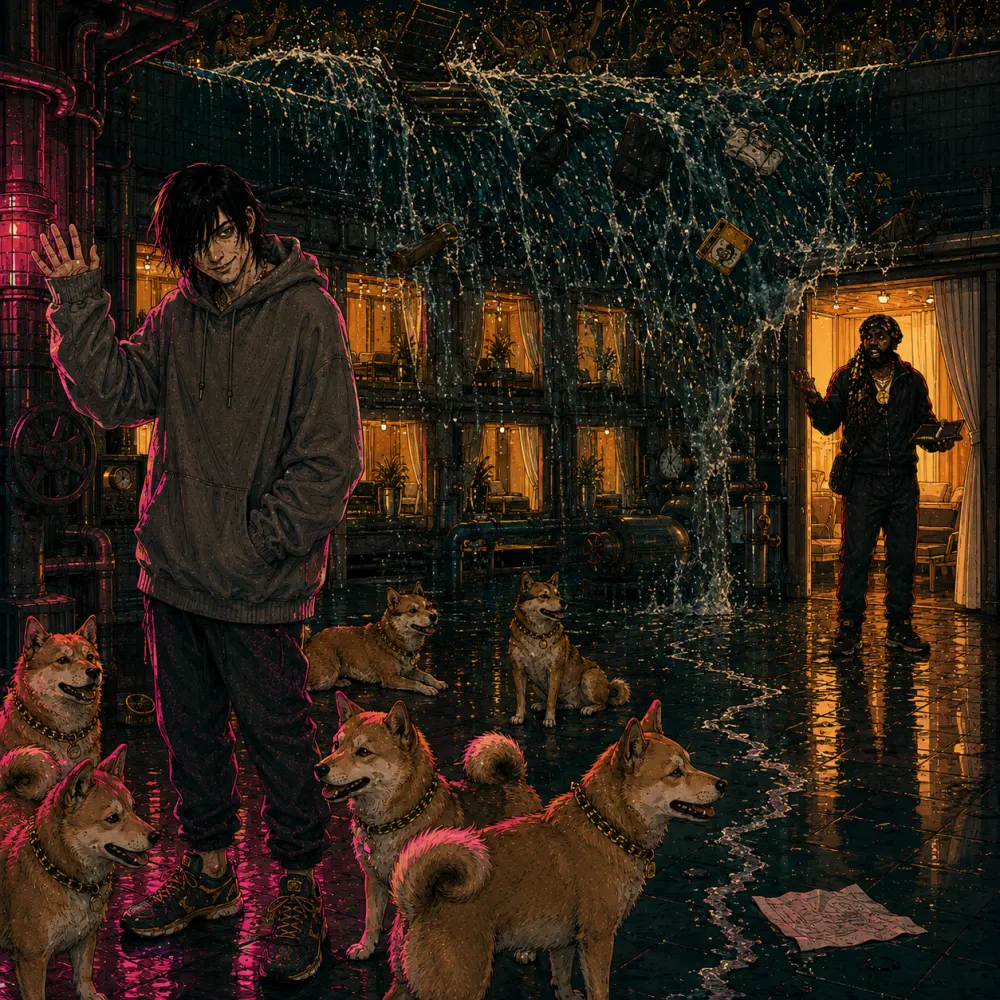
Play “Rug Pulls Pay My Rent” in Hip Hop Hero →
Lyrics
Listen while you read
- Getting rich is magic but rug pulls are tragic!
- I know they want revenge
- [Hook]
- 7 ETH on me, love the gas scent
- Invest with me, I’m fresh as a mint
- Steal (still) on chain, real gold bricks
- Will scam a normie, when the market dips
- Anonymous. That's the way that I’m livin
- Cold wallet on me, data stays encrypted
- hungry Hackers, I can see their ribs
- Honey pots in my Shiba crib
- WAGMI, from the sound of it
- Hit my plug with straight counterfeit
- Paper hands will never last thru the bear
- Trade from a stolen Metamask. I’m rare
- Dead presidents betrayed my frens
- Rug pulls pay my rent
- Scammed a Degen. It was cringe
- The way I did him. I know he wants revenge
- [Verse]
- Take profits. Stay vigilant
- Kennel full of DOGE. My puppy’s are ignorant
- Selling in the green, wait and buy the dip
- Bored Apes go bananas wit their clips
- Swimming with whales and they’re sinking ships
- “I’ll be stinking rich!” We’re all thinking this
- Bearish candlestick. Can it switch?
- Day ones swing it. Can you handle dips?
- Rugged all my opps. This game ain’t honest
- Thug on the blockchain, love prevents conflict
- Hop out the lambo, I feel like John Wick
- White collar scandals but not a convict
- Crypto jacker. Know this!
- Got my young hacker doxxing their whole clique
- Don’t get distracted. Safe til we cracked it
- It’s dry. Try sticking them up like a cactus
- Pull up on your block chain, it’s gon' get tragic
- Stopped buying stocks cuz Bitcoin is magic
- I feel like Houdini, Makin dips vanish
- My foreign girl makes, her plays in Spanish
- NFT zoo. Don’t feed the bears and bulls
- Lots of rug pulls. Don’t get too comfortable
- Selling meme tokens. You’re gonna pay taxes
- Sleep on ‘em so hard you pissed on your mattress
- Stole from your family managing Robinhoods
- Told your granny, it’s hard to stop when you should
- Price low, gas high. Anything can happen
- I won’t even ask why, you won’t make transactions
- I feel like Satoshi the way that I'm stackin’
- Caught you down bad. Only holding a fraction
- Bullish on ETH
- Vitalek’s is the captain
- Seed phrase lost in the napkin it was wrapped in
- [Hook]
- 7 ETH on me, love the gas scent
- Invest with me, I’m fresh as a mint
- Steal (still) on chain, real gold bricks
- Will scam a normie, when the market dips
- Anonymously. That's the way that I’m livin
- Cold wallet on me, data stays encrypted
- hungry Hackers, I can see their ribs
- Honey pots all in my Pepe’s crib
- WAGMI, from the sound of it
- Hit my plug with straight counterfeit
- Paper hands will never last thru the bear
- Trade from a stolen Metamask. I’m rare
- Dead presidents betrayed my frens
- Rug pulls pay my rent
- Scammed a Degen. It was cringe
- The way I did ‘em. I know he wants revenge
- Getting rich is magic
- rug pulls are tragic!
- I know they want revenge
Annotations
This track is written from the attacker's point of view. Every annotation below carries a Danger field, and the facing Defense Sheet maps each technique to its countermeasure.
Define — A rug pull is when a project's operators withdraw the funds backing a token and disappear, leaving holders with something they cannot sell.
Decode — The album's villain introduces himself by naming his own trade and calling it tragic. The distance between "magic" and "tragic" is one rhyme and the entire moral of the record.
Danger — This is the most common way money is taken in new token markets. It requires no hacking: the operators simply use access they always had. Track 5's narrator lost a wallet to strangers; this is the voice of the stranger.
See also — rug-pull, liquidity-locked, Defense Sheet row 1, Manual Part Four §4.
Define — To mint is to create a new token on a chain — usually the first sale of an item in a collection.
Decode — The pun is the pitch. "Fresh as a mint" is a solicitation, and the whole hook is written as an advertisement.
Danger — Fake mint pages are the most common launch-day attack. The transaction they ask you to sign is not a purchase — it is an approval that lets the contract take what you already hold.
Do — Never mint from a link in a chat, reply, or message. Reach the project's real site independently and read what the transaction actually does before signing.
See also — mint, wallet-drainer, contract-approval, Defense Sheet row 2.
Decode — Target and timing, stated outright. Newcomers, at the moment they are most anxious.
Danger — This is real targeting logic. Scam volume rises during downturns, because fear makes recovery offers and guaranteed yields far more persuasive than they are in a calm market.
Do — Treat any opportunity that arrives during a crash with more suspicion, not less. Urgency plus a falling market is the exact combination this bar describes.
See also — normie, fomo, bear-market, Defense Sheet row 3.
Decode — Anonymity as operational necessity rather than principle. The same property that protects a legitimate developer protects him.
Danger — Anonymity is not itself a red flag — Bitcoin's author was anonymous. It becomes one when combined with custody of other people's funds and no verifiable delivery history.
Do — Judge the checkable things instead: is the contract verified, is liquidity locked and until when, is there an audit naming a firm and a date, and has this team shipped anything before.
See also — anon, code-audit, liquidity-locked, Defense Sheet row 4.
Define — A cold wallet keeps keys on a device that has never touched the internet. Encryption scrambles data so only a key holder can read it.
Decode — The attacker practises excellent security on his own holdings. That is not irony — it is how this actually works, and it is why the defensive advice in this book is worth taking.
Danger — Note what he protects and what he does not. Good custody hygiene protects the person holding it, whoever they are; it says nothing about whether they are honest.
Do — Take his side of it. Buy hardware direct from the maker, never from a marketplace reseller, and generate the recovery phrase yourself on the device.
See also — cold-wallet, encryption, Manual Part Two §4.
Define — A honeypot is a token you can buy but cannot sell — the restriction is written into the contract.
Decode — Kept at home, plural, like stock. This is inventory, not a one-off.
Danger — The chart looks healthy the entire time, because buys succeed and only sells fail. Everyone still holding is someone who has not yet tried to leave. You find out at the exact moment you need out.
Do — Before buying anything obscure, check whether anyone has successfully sold it. Buys with no corresponding sells is the visible shape of this trap.
See also — honeypot, token-tax, Defense Sheet row 5, Manual Part Four §4.
Define — WAGMI — "we're all gonna make it." A rallying phrase.
Decode — "From the sound of it" is the tell. He is using the community's own language as camouflage, and admitting it in the same breath.
Danger — Shared optimism is not information, and it is trivially manufactured. A channel where everyone agrees is usually a channel where everyone holds the same thing — including the people who sold it to them.
See also — wagmi, fomo, normie.
Decode — Counterfeit supply moved through a trusted contact. The "plug" is the introduction that makes it credible.
Danger — Fake tokens impersonating real projects are everywhere, using identical names and logos. Buying from a link someone trusted sent you is a standard route into one, and a warm introduction is exactly what makes people skip verification.
Do — Get contract addresses from the project's own official channel, never from a forwarded message, and compare them character by character.
See also — rug-pull, phishing, Defense Sheet row 6.
Define — Paper hands is an insult for selling quickly, usually out of fear. A bear market is an extended period of falling prices.
Decode — The attacker deploying the culture's own shaming vocabulary. He needs people not to sell.
Danger — This is the insult working as a tool. Anyone who benefits from you holding has a reason to call selling weakness. Taking profit is not weakness, and pressure not to sell should be read as information about the person applying it.
See also — paper-hands, take-profits, diamond-hands, Defense Sheet row 7.
Define — MetaMask is a widely used browser and phone wallet. It is taught fully at track 9; here it is simply the wallet being stolen from.
Decode — Trading from someone else's wallet, and calling it a rarity trait. The collectible vocabulary applied to theft.
Danger — A wallet is "stolen" when someone obtains the recovery phrase — most often from a fake wallet extension installed via a search advert, or a phrase typed into a convincing fake site. No cryptography is broken.
Do — Install wallet software only from the official site reached by your own bookmark, never a search result. No legitimate service will ever ask for your recovery phrase.
See also — metamask, phishing, recovery-keys, Defense Sheet row 8.
Decode — Money as the betrayer, so he does not have to be. It is the standard self-justification, and the album lets him make it without endorsing it.
Danger — Worth naming plainly: the people harmed here are described as friends. Most crypto fraud is committed by someone the victim already trusted, not by a stranger. Affinity fraud is the dominant pattern.
See also — ponzi, pooled-funds, Manual Part Four §5.
Decode — The title line. Not a fortune, not a yacht — rent. The scam economy as an ordinary job, which is the most unsettling thing on the record and the reason the track works.
Danger — This is accurate. Much of this activity is industrialised and routine, run by people treating it as work with volume targets. It is not rare, dramatic, or personal, and it is not aimed only at the wealthy.
See also — rug-pull, Defense Sheet, Manual Part Four §1.
Define — Taking profits means selling a portion while up, converting a paper gain into a real one.
Decode — The villain's own risk management, and it is better than the hero's. He sells. Everyone he sells to does not.
Danger — Read alongside a09, this is the whole asymmetry: he takes profits while telling everyone else that selling is weakness. Both bars are in the same verse.
Do — Decide in advance what would make you sell a portion, and write it down. Any rule beats none, because the alternative is deciding under emotion.
See also — take-profits, paper-hands, Manual Part Five.
Decode — Sell into strength, buy into weakness. Stated flatly, it is unremarkable discipline — and it is the opposite of what the crowd is doing in every other track.
Danger — Sound as a principle and dangerous as a slogan. "Buy the dip" with no limit is how people average down into something that never recovers. He has an exit; the people following the slogan do not.
See also — buy-the-dip, green-candle, dip.
Define — Bored Ape is a well-known profile-picture NFT collection launched in 2021, which became the reference point for the category.
Decode — The status symbol of the last cycle, invoked as shorthand for the whole scene.
Danger — It was the exception, not the template. Most collections that copied it are now worth close to nothing, and reasoning from its peak prices to any other collection is how a great deal of money was lost.
See also — bored-ape, floor-price, mint, Manual Part Five §3.
Define — A candlestick shows the open, close, high and low over one period.
Decode — The question everyone asks at the same moment, and nobody can answer.
Danger — Candlestick patterns are widely sold as predictive. A chart records what already happened; it is a description, not a forecast. Anyone charging for the ability to read the future in them is selling confidence.
See also — candlestick, fake-guru, retrace.
Decode — "This game ain't honest" is offered as the justification: everyone does it, so doing it is neutral.
Danger — The reasoning is worth naming because it is the standard one, and because it is how people talk themselves across the line. The market having bad actors is not a defence for being one, and it is not a reason to assume everyone is.
See also — rug-pull, dyor.
Decode — The boast is about impunity, not wealth. He has not been caught, and he expects not to be.
Danger — Largely accurate, and the reason self-defence matters more here than elsewhere. Cross-border, pseudonymous, low individual loss amounts — most of this is never prosecuted, and there is no chargeback. Prevention is effectively the only remedy.
See also — rug-pull, immutable, Manual Part Four §1.
Define — Doxxing is publishing someone's real identity, address, or workplace, usually to intimidate them.
Decode — The escalation from financial attack to personal attack, and the moment track 8 hands off to track 9.
Danger — On a public ledger, linking a name to an address exposes a balance permanently and to everyone. That link is what turns a holder into a target, and it cannot be undone once made.
Do — Keep public activity separate from the wallets holding savings. Do not publish addresses next to your name, and check what photographs reveal about where you live.
See also — doxxing, opsec, coercion, Defense Sheet row 9, track 9.
Decode — The first physical threat on the album. It is glancing, and it is the door track 9 walks through.
Danger — Robbery of crypto holders in person is a documented and growing category. It bypasses every technical defence, because cryptography protects keys from computers and does nothing about a person in the room.
See also — coercion, duress-wallet, multisig, track 9.
Decode — Advice, from the attacker, and it is correct. He is telling you what he does and expecting it to change nothing.
Danger — Comfort is the actual vulnerability. Most people are careful with their first transaction and careless by their fiftieth, and that is precisely when the loss happens.
Do — Keep the same routine at transaction one thousand as at transaction one: bookmark, verify the address, small test amount, read what you are signing.
See also — rug-pull, contract-approval, Manual Part Four.
Define — Two different things share this word. Token tax is a fee written into a token's own code taking a cut of every buy or sell. Government tax is what this bar means.
Decode — The mundane consequence nobody puts in a song, dropped in by the villain as a parting unpleasantness.
Danger — Both apply. A contract's sell tax can often be raised after launch, to near-total, once enough people are in. And in most countries every disposal is a taxable event, including swapping one token for another — people discover a large bill for trades that netted them nothing.
Do — Read the contract's buy and sell tax before purchasing, and keep a running record of dates, amounts, and values in your own currency from the start.
See also — token-tax, cost-basis, honeypot, Manual Part Three §6.
Define — Pooled funds — several people's money combined, with one party controlling the wallet.
Decode — The Robin Hood inversion is the joke: taking from those he was supposed to be managing for.
Danger — This is affinity fraud, the most common serious loss pattern in retail crypto. Someone trusted offers to manage funds for family or friends, holds a single wallet, and can leave with everything whatever was agreed.
Do — Never hand funds to an individual to manage. If money must be pooled, use a multisig with independent signers so no one person can move it alone.
See also — pooled-funds, multisig, ponzi, Defense Sheet row 10.
Decode — Targeting an older relative, and admitting the compulsion in the same line. It is the closest the character comes to self-awareness.
Danger — Older people are targeted deliberately and disproportionately, most often through romance approaches, fake support calls, and "recovery" services that promise to retrieve funds already lost. The recovery scam is a second theft aimed at people who have already been robbed once.
Do — Tell the older people in your life two rules: nobody legitimate asks for a recovery phrase, and nobody who contacts you first can get your money back.
See also — fake-guru, phishing, Manual Part Four §5.
Define — Gas is the fee to have a transaction processed; it rises with demand for block space.
Decode — The two conditions together, named as the moment of maximum chaos.
Danger — This is the trap in one bar. Prices crash and fees spike simultaneously, so the moment you most want to move funds is the moment it is most expensive and least reliable. Transactions stall or fail, and people panic into worse decisions.
Do — Rehearse any emergency transfer while the network is quiet, with a small amount, so you know the steps and the cost before you need them.
See also — gas-price, network-congestion, layer-2.
Decode — He knows exactly why. The victim cannot transact because the contract does not permit it, and the feigned incuriosity is the cruelty.
Danger — This is the honeypot from the inside. The balance is visible, the wallet is intact, and the sell simply fails. Nothing was stolen in a way any explorer will show as theft.
Do — Check that sells are going through for any token before you buy it. A token with buys and no sells is this bar.
See also — honeypot, token-tax, Defense Sheet row 5.
Decode — The victim, later, holding a fraction of what they put in. This is the outcome the whole track has been describing, seen from the other side.
Danger — "A fraction" is the realistic result, not zero and not recovery. People stay in a position that has lost most of its value because selling makes the loss final, and the fraction erodes further while they wait.
See also — rekt, bear-market, take-profits.
Define — The seed phrase is the list of words that restores a wallet. Lose it and the funds are unreachable permanently; there is no reset and no appeal.
Decode — The album's darkest joke, and the last line of the verse. Not stolen — mislaid. Written on a napkin, and the napkin thrown away.
Danger — This is not a hypothetical. A substantial share of all Bitcoin is already permanently unreachable this way. Fire, flood, a house move, and a tidy-up end more wallets than attackers do, and there is nobody to appeal to.
Do — Write the words on paper or stamped metal, never a napkin, note app, photo, or cloud document. Two copies, two separate buildings. Then test a recovery with a small amount, so you know the copy actually works before you need it.
See also — seed-phrase-loss, recovery-keys, generational-wallet, Manual Part Two §5.
Defense Sheet
This track is written from the attacker's point of view. Everything described here is a real technique with real victims. Read the left page for the attack. Read this page for the defence.
The attacks, and what stops them
| # | The attack (from the lyric) | How it actually works | What stops it |
|---|---|---|---|
| 1 | "Rug pulls pay my rent" | The operators withdraw the funds backing the token and disappear. No hacking — they use access they always had. The token stays in your wallet with nothing left to sell it against. | Check that liquidity is locked and read the unlock date before buying. It is public and free to check. A lock expiring next week is not a lock. |
| 2 | "Invest with me, I'm fresh as a mint" | A fake mint page, promoted on launch day. The transaction is not a purchase — it is an approval letting the contract take what you already hold. | Never mint from a link in a chat, reply, or message. Reach the project's real site independently. Read what the transaction actually does before signing. |
| 3 | "Will scam a normie, when the market dips" | Deliberate targeting of newcomers during downturns, when fear makes guaranteed yields and recovery offers persuasive. | Treat opportunities arriving during a crash with more suspicion. Urgency plus a falling market is the exact combination being described. |
| 4 | "Anonymous. That's the way that I'm livin" | Anonymity plus custody of other people's funds, with no delivery history to check. | Judge the checkable things: verified contract, locked liquidity with a date, an audit naming firm and version, and what the team shipped before. Anonymity alone is not the red flag — anonymity plus custody is. |
| 5 | "Honey pots in my Shiba crib" · "you won't make transactions" | The contract permits buying and blocks selling. The chart looks healthy throughout because only sells fail. | Before buying anything obscure, check that sells are going through. Buys with no corresponding sells is the visible shape of the trap. |
| 6 | "Hit my plug with straight counterfeit" | Fake tokens impersonating real projects — identical name, identical logo — passed through a trusted introduction so verification gets skipped. | Get contract addresses from the project's own official channel, never a forwarded message, and compare them character by character. |
| 7 | "Paper hands will never last thru the bear" | The culture's shaming vocabulary used to stop holders selling, by someone who benefits from them holding. | Read pressure not to sell as information about the person applying it. Note that the same verse says "take profits" — he sells; you are told not to. |
| 8 | "Trade from a stolen Metamask" | The recovery phrase is obtained — usually a fake wallet extension from a search advert, or a phrase typed into a convincing fake site. No cryptography is broken. | Install wallet software only from the official site via your own bookmark, never a search result. No legitimate service ever asks for a recovery phrase. |
| 9 | "Got my young hacker doxxing their whole clique" | Real identity published and linked to a wallet address. On a public ledger this exposes the balance permanently, to everyone. | Keep public activity separate from savings wallets. Never publish an address beside your name. Check what photographs reveal about where you live. |
| 10 | "Stole from your family managing Robinhoods" | Affinity fraud. Someone trusted offers to manage funds for family or friends, holds one wallet, and leaves with everything. | Never hand funds to an individual to manage. If money must be pooled, use a multisig with genuinely independent signers so no one person can move it alone. |
| 11 | "Seed phrase lost in the napkin it was wrapped in" | Not theft — loss. The words are mislaid, and there is no reset, no appeal, and nobody to ask. | Paper or stamped metal, two copies, two separate buildings. Never a photo, note app, or cloud document. Then test a recovery with a small amount. |
Threat model summary
The person in this track is not a hacker and does not attack the blockchain. He runs a small business built on ordinary access — he launches tokens, controls their liquidity, and withdraws it. His targets are newcomers, people he already knows, and the elderly, and his advantage is that almost none of this is ever prosecuted: cross-border, pseudonymous, individually small. Realistically, anyone buying a new token from an unverified team is exposed to this, and the exposure is proportional to how new the token is and how little of it can be checked. The defence is not sophistication. It is refusing to skip four free checks — liquidity lock, contract verification, holder concentration, and whether sells work.
The one thing
Before you buy anything, check that liquidity is locked and that other people can still sell — both are free, public, and take about ninety seconds.